MochiCloner Premium & Add‑ons
- 3.5
- Rating
- 100.00K
- Installs
- Free
- Price

 Analysis by App-foxy
I approached MochiCloner Premium & Add-ons as a practical tool rather than a flashy utility. Its store summary describes it as a subscription and add-on management app, while the short description simply calls it “MochiCloner.” That leaves the important question to the actual experience: can it make recurring services and optional extras easier to understand and control?
My answer is cautiously positive. The app has a focused purpose, a free entry point, and a simple enough concept for everyday use. At the same time, it is not the kind of application I would install automatically just because I have several subscriptions. Its value depends on how clearly it presents the services you manage and how much discipline you bring to keeping that information current.
Starting with a clean subscription routine
The most useful way to begin is to treat MochiCloner as a central checklist for recurring commitments. I would not open it expecting it to replace every account page, payment provider, or app-store control panel. Instead, I would use it to establish one repeatable view of what I pay for, which extras matter, and what needs attention before the next renewal.
You May Also Like

 Blood Strike: 2.5 Anniversary
Blood Strike’s Loadouts Turn Every Drop Into a Tactical Gamble
A close look at Blood Strike’s custom loadouts: how fast access to signature weapons reshapes its battle royale rhythm, rewards preparation, and narrows the gap between fights.

 Pandora - Music & Podcasts
Pandora’s Music Is Easy to Start, but Harder to Recover
Pandora’s strength is its low-effort path from a seed to a station. Its weak spot is how much confidence it asks you to place in connection, setup, and quiet recovery.

 8 Ball Pool
 Is Built on Rivalries, Rematches, and Routine
A close look at the rivalries, rematches, shared routines, and unanswered safety questions that turn a quick pool match into a persistent mobile community.

 Samsung Music
’s Quiet Strength Is Playing What You Already Own
Its reach comes less from spectacle than from dependable access to a personal library. That simplicity is both the app’s strongest retention engine and its ceiling.

 AccuWeather: Weather Radar
AccuWeather Review: A Quick, Clear Forecast for Everyday Decisions
For everyday plans, the best forecast is the one you can understand quickly. AccuWeather makes rain timing, radar, and local conditions easy to act on, with a few trade-offs.

 Hill Climb Racing
Why Hill Climb Racing Still Turns Crashes Into One More Run
A tiny car, a bumpy hill and one more upgrade: Hill Climb Racing keeps resurfacing because its simple chaos makes every near-miss feel personal.
More From Our News Desk



A realistic example is a busy month in which I have a streaming service, a cloud-storage plan, a fitness membership, and one optional add-on attached to another service. The problem is rarely remembering that these products exist. The problem is remembering why I still use each one, whether an add-on is still useful, and where the cancellation or change process actually lives. A management app can reduce that mental load, but only if I enter information carefully and review it regularly.
That is where the app’s narrow identity helps. Rather than trying to be a general finance package, it is centered on subscriptions and add-ons. For someone who wants a dedicated place to think about recurring services, that focus is easier to work with than a broad budgeting app filled with unrelated categories.
I would start by adding only the subscriptions I actively recognize. This sounds obvious, but it prevents a common mistake: creating a long, messy list based on old trials, forgotten accounts, and services that are already inactive. A smaller, accurate starting point gives the app a useful baseline. After that, I would add optional extras separately where the app allows that distinction, because an add-on can be easy to overlook when it is mentally grouped with the main service.
The strongest habit is not adding everything once; it is reviewing the list at the same point in every billing cycle. I prefer a short weekly check for new commitments and a more deliberate monthly review for services I might cancel or downgrade. MochiCloner becomes more useful when it supports that habit instead of becoming another forgotten icon on the phone.
What I would check before trusting the list
My first check would be clarity. Can I tell which entry is the main subscription, which one is an add-on, and which one needs a decision? If the answer is yes, the app is doing something valuable even before I make changes. If every item looks equally urgent, I would need to create my own simple naming or grouping routine so that the list reflects real priorities.
I would also verify each entry against the account where the subscription is actually billed. A management app is only as reliable as the details I maintain inside it. This matters especially when a service can be purchased through different platforms or when an add-on belongs to a separate account. I would not assume that recording an item inside MochiCloner automatically changes the underlying subscription.
That distinction is important for new users. The app can help me organize decisions, but I still need to use the relevant service, store, or payment account to confirm a cancellation, change a plan, or remove an add-on. My preferred workflow is to mark the item for review in the app, open the official management screen, complete the change there, and then update my record immediately.
This two-step approach may feel slower than relying on a single dashboard, but it avoids a dangerous misunderstanding. A note that says “cancel” is not the same as a confirmed cancellation. I would keep MochiCloner as the planning and tracking layer, while treating the original provider as the final authority for account changes.
Settings and small choices worth checking
Because the product includes premium and add-on elements, I would examine the available settings before building a large collection of entries. The goal is not to turn the app into a complicated project. It is to make sure the way I organize information matches the way I make decisions.
I would look for options that affect how entries are displayed, how optional purchases are separated from core subscriptions, and how the app handles reminders or review prompts if those controls are available. I am careful not to enable every alert immediately. Too many notifications can make an important reminder blend into the background, so I would begin with only the prompts connected to decisions I genuinely need to make.
Another useful setting choice is consistency. If the app lets me label or categorize entries, I would use a small vocabulary such as “keep,” “review,” and “cancel.” I would avoid creating a different label for every mood or reason. The point is to make a quick scan meaningful. A short, stable system is more useful than a detailed one I stop maintaining after a week.
I would also decide whether add-ons deserve their own review interval. In my experience, optional extras should be inspected more often than a service I use every day. The main subscription may be obvious, while a small enhancement can continue unnoticed because it does not feel like a separate purchase. Keeping those items visually or mentally distinct is one of the better reasons to use a focused manager.
There is a trade-off here. A dedicated organizer can make recurring commitments visible, but it also introduces another place to update. If I already maintain an accurate budget spreadsheet and regularly inspect every account, MochiCloner may duplicate work rather than remove it. I would choose it when I need a lighter, more immediate review process, not when I want another full financial system.
Faster patterns for people with many services
Once the basic list is clean, I would use repeatable patterns instead of opening the app randomly. One pattern is the “new commitment” check: whenever I begin a trial, activate a plan, or add an extra feature, I record it immediately. Waiting until the end of the month creates gaps, especially when several services use different billing arrangements.
A second pattern is the “decision before renewal” review. I would open the app before a renewal window, ask whether I used the service recently, and decide whether the next period has a clear purpose. If the answer is uncertain, I would visit the official account page while the decision is still easy to act on. This is more effective than reviewing expenses after the charge has already happened.
A third pattern is separating essential services from convenience services. I would not judge both groups by the same standard. A cloud plan used for important files may be worth keeping even if I do not open it every day, while an entertainment add-on should probably justify itself through regular use. MochiCloner’s usefulness improves when I bring that reasoning into the review instead of treating every line as a simple yes-or-no expense.
For a household, I would be especially careful about ownership. If one person pays and another person uses the service, I would record enough context to avoid accidental cancellation or confusion. A shared review can identify duplication, but it should not turn into a rushed decision based only on a list. The person responsible for the account should confirm the change.
Experienced users can also use a “quiet period” rule. When I am unsure about an optional add-on, I would mark it for review and avoid adding more extras until I decide whether it has a real role. This prevents the common pattern of keeping an add-on simply because removing it feels like effort. The app cannot make that judgment for me, but it can give the decision a visible place.
These workflows are more valuable than repeatedly browsing the same screen. The app becomes a small operating routine: capture new commitments, separate core plans from extras, review before renewal, confirm changes at the source, and clean up the record afterward.
Where premium access and add-ons fit
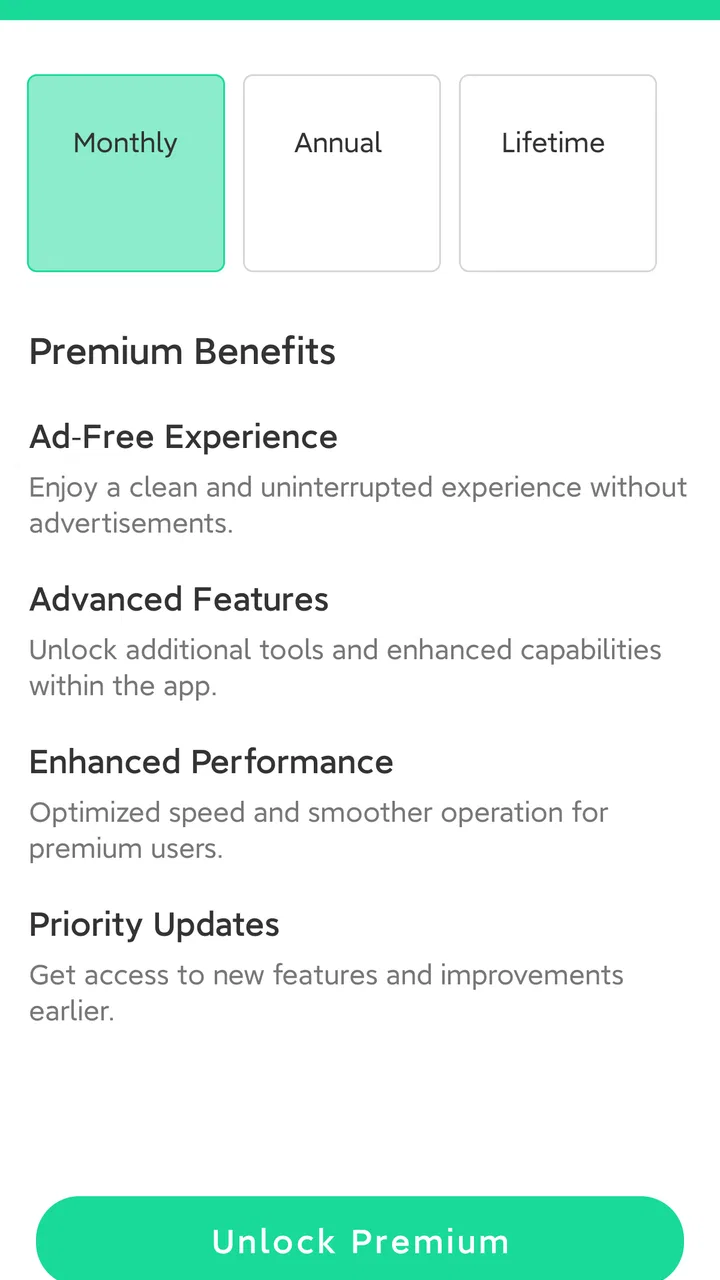
The app is free to download, but premium access and add-ons are part of its commercial model. Individual in-app purchases range from a few dollars to amounts approaching eighty dollars per item, so I would not unlock anything automatically. I would first use the basic experience long enough to identify a specific limitation in my own workflow.
That is the right test for this kind of app. If the free version already lets me maintain a clear list and perform my normal review routine, a paid option should save meaningful time or provide a capability I will use repeatedly. Paying simply because the word “premium” appears would not be a good reason.
I would also distinguish between a one-time convenience and an ongoing dependency. An add-on that helps with a particular organization task may be worthwhile if it removes repeated manual work. But if it creates another layer of information that must be maintained, the purchase could make the routine more complicated. My rule would be to compare the extra feature with the time and attention it demands, not just with its price.
Since the product is designed around subscriptions and extras, the purchasing experience itself deserves attention. I would read each purchase screen carefully, check whether the item is optional, and make sure I understand what I am enabling before confirming. A management tool should encourage careful decisions, and users should apply that care to the app’s own premium choices as well.
Advanced limits that shape my recommendation
The biggest limitation is conceptual: MochiCloner is not a replacement for the original billing systems. I would not use it as proof that a payment has stopped, nor would I expect it to resolve account disputes or provider-specific cancellation rules. Its role is strongest when I need organization and weakest when I need direct authority over an account.
There is also a maintenance cost. Every dedicated tracker can become inaccurate if I change a plan elsewhere and forget to update it. That risk is not a reason to reject the app, but it is a reason to keep the routine simple. I would rather maintain ten accurate entries than create a detailed archive that no longer reflects reality.
People who want automatic financial analysis may prefer a banking or budgeting application that connects directly to their transactions. That alternative can be better for seeing actual charges and broader spending patterns. MochiCloner makes more sense for someone who wants a focused subscription-and-add-on view, especially when the main problem is remembering decisions rather than analyzing every purchase.
It may also be the wrong choice for someone with only one recurring service and no interest in tracking extras. In that situation, the provider’s own account page is probably enough. The app earns its place when several commitments compete for attention or when optional features are easy to overlook.
Its age rating is Everyone, which fits the straightforward organizational purpose. The app is published by lyt team, has a current version of 1.0.0, and runs on Android starting with version 8.0. Those details make it accessible to a broad range of Android users, though I would still judge it by whether it fits my personal routine rather than by compatibility alone.
The listing shows over fifty thousand installs, but the average rating is currently zero. I would treat that combination as a reason to evaluate the app directly and keep expectations measured, not as a clear signal that it is either excellent or poor. A new or lightly reviewed product deserves a short trial with real entries before it becomes part of an important financial habit.
My verdict after building a repeatable routine
I see MochiCloner as a focused organizer for people who want subscriptions and add-ons in one deliberate review space. I like the idea of using it as a lightweight control panel for decisions: record the commitment, distinguish the optional extra, review it before renewal, and confirm any change through the actual provider.
My recommendation is strongest for users who regularly forget why they subscribed, discover small extras months later, or want a dedicated alternative to a broad budgeting app. The app can also suit someone who prefers a simple manual routine over connecting financial accounts to a larger service.
I would skip it if I already have a reliable system that automatically reflects charges and I am comfortable maintaining it. I would also avoid paying for premium features until the basic workflow reveals a problem worth solving. The free starting point makes that test practical, and the paid range means a little restraint is sensible.
After using this kind of routine, my final judgment is that the app’s success depends less on cleverness than on consistency. It will not cancel services for me, explain every provider’s billing rules, or replace careful account management. What it can do is make recurring commitments visible enough to question them at the right time. For me, MochiCloner is worth considering as a focused subscription notebook with a practical workflow, provided I treat it as a companion to official account controls rather than a substitute for them.
FAQs for MochiCloner Premium & Add‑ons
01What is MochiCloner Premium & Add-ons?
MochiCloner Premium & Add-ons is an advanced app designed for creating and managing digital flashcards. It offers a range of premium features for effective study sessions, such as customizable templates, multimedia integration, and advanced analytics. The app is available for both Android and iOS, providing users with a versatile tool for learning on the go.
02How does the subscription model work for MochiCloner Premium?
MochiCloner Premium operates on a subscription model, offering monthly and yearly plans. Subscribers gain access to exclusive features, including unlimited flashcard sets, enhanced customization options, and priority support. The app also offers a free trial period, allowing users to explore premium features before committing to a plan.
03What are the key features of MochiCloner Add-ons?
MochiCloner Add-ons extend the app’s functionality with specialized tools and integrations. These include options for syncing with other educational platforms, importing data from various formats, and using third-party plugins to enhance the learning experience. Add-ons can be purchased separately or as part of a bundle with the premium subscription.
04Is MochiCloner suitable for all ages and educational levels?
Yes, MochiCloner is designed to be versatile and user-friendly, making it suitable for learners of all ages and educational levels. Whether you're a student, professional, or hobbyist, the app's customizable features and intuitive interface cater to a wide range of learning needs and preferences.
05How does MochiCloner handle data privacy and security?
MochiCloner prioritizes user data privacy and security with robust measures. All personal data and flashcard content are encrypted both in transit and at rest. The app complies with industry standards and regulations to ensure that user information is protected. Additionally, users can manage their data preferences through the app's settings.
Pros
- User-friendly interface with intuitive navigation.
- Offers a wide range of cloning options.
- Regular updates with new features.
- Excellent customer support and resources.
- High compatibility with various devices.
Cons
- Premium features are costly for some users.
- Occasional bugs in newer updates.
- Limited free version capabilities.
- Requires a stable internet connection.
- Some features have a steep learning curve.

MochiCloner Premium & Add‑ons
Gallery